Narrative Structure in Series A and Series B Pitch Decks
Successful pitch decks answer different investor risk questions at Series A versus Series B.

Here's the reframe that makes everything else click: pitch decks are not presentations. They are answers to a specific set of investor risk questions. The architecture signals which questions the founder actually understands are on the table.
Get the question wrong, and it doesn't matter how good the answer is. It's like bringing the right key to the wrong door.
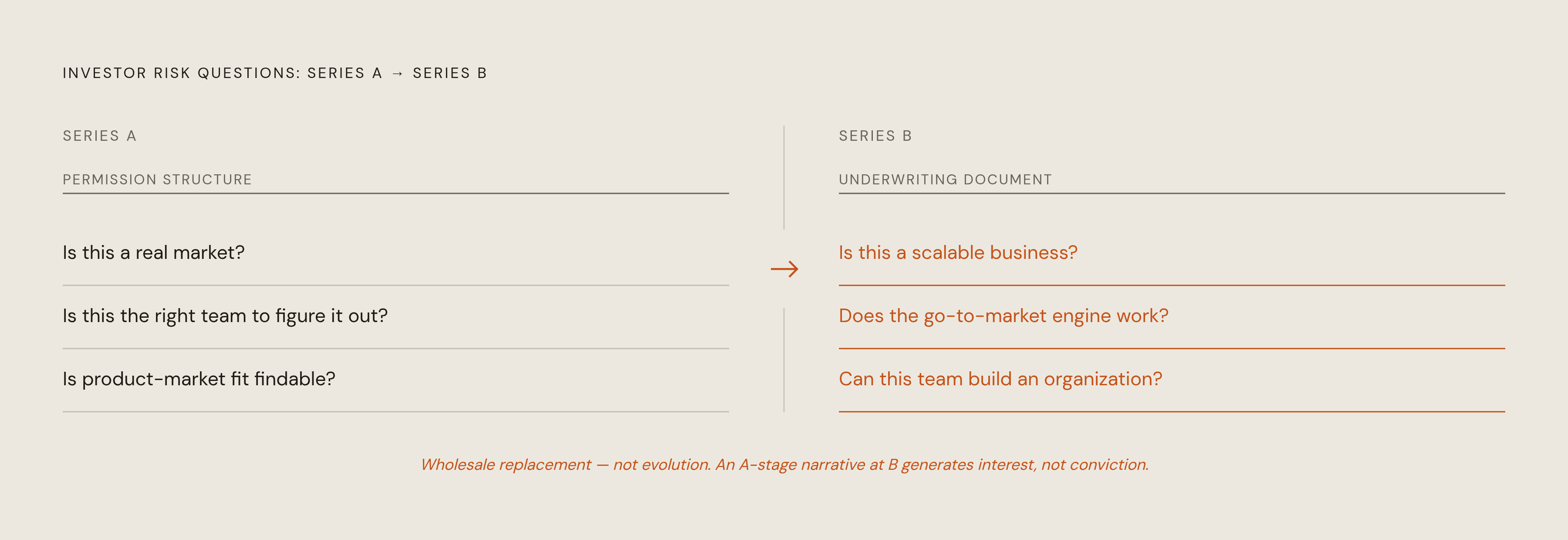
At Series A, the risk questions look like this:
- Is this a real market?
- Is this the right team to figure it out?
- Is there early evidence that product-market fit is findable?
Notice what's missing. Not "is this a proven business." Not "does the go-to-market engine scale." A-stage investors are still pricing founder risk and thesis risk. They want to see that you see something the market doesn't yet, and that early traction is signal rather than noise.
At Series B, the questions shift entirely:
- Is this a scalable business?
- Does the go-to-market engine actually work?
- Can this team build an organization, not just a product?
Now they're pricing execution risk and capital efficiency risk. The narrative must convey system, not story. The deck's job is to demonstrate that what worked in the first markets will work in the next ten, and that the company knows why it works.
One way to hold this distinction: A-stage decks are permission structures. Convince me this is worth investigating. B-stage decks are underwriting documents. Convince me the model is proven and scalable.
Founders who miss this walk into an underwriting meeting with a permission-structure narrative. They generate interest. They don't generate conviction. And they leave genuinely puzzled, because the numbers looked fine.
DocSend's analytics put a hard number on how fast this plays out. The average first-pass deck review runs just over two minutes. The first four slides capture roughly 60% of total investor attention. If those slides aren't answering the stage-appropriate risk question, the room is already somewhere else before you've made your actual case.
The Narrative Architecture of a Series A Deck: Making the Case for a Category That Doesn't Fully Exist Yet
The Series A narrative arc runs roughly like this: Problem, Insight, Product as proof of insight, Early traction as signal, Team as thesis-holders, Ask.
The logical spine is the insight. The non-obvious belief about how the world works that makes this the right product at the right time. Without a clearly stated insight, the deck collapses into a feature list with a market size slide. That reads as undifferentiated, and every investor has seen fifty of those this month.
Problem framing at Series A has a specific job. It's not enough to prove the problem exists. The slide must establish that the problem is real, widespread, and currently mis-served, and it needs to name a specific, identifiable sufferer. A persona. A moment. A cost that someone is actually bearing right now.
YC has been consistent on this point: the most common structural failure is a problem slide that describes a category rather than a felt pain. "Enterprises struggle with data silos" is a category description. "The VP of Sales at a 300-person SaaS company loses eleven hours a week reconciling pipeline data across three disconnected tools" is a felt pain. One makes the investor nod politely. The other makes them lean forward.
Traction at Series A functions as evidence for the insight, not proof of the business. The right framing question is whether the traction slide explains why customers converted, not just that they did. A-stage investors are looking for leading indicators: retention curves, expansion revenue, referral rates. Revenue is good. Revenue that explains the thesis is better.
The category flag. A-stage decks should plant it even if the category isn't fully named yet. The Play Bigger framework argues the company that names and defines a category captures the majority of total value created in it. At Series A, the category claim doesn't need its own slide, but the language of the deck should make clear the founder is not competing inside an existing bucket.
The team slide at A-stage should answer why this team has the specific insight. Not just the credentials. Domain expertise, lived experience with the problem, prior evidence of founder judgment. Those carry more weight than pedigree alone, at least with investors who've been burned by the inverse.
On slide count: YC's guidance and DocSend's analytics converge around 12 to 15 slides as the functional ceiling before engagement drops. The goal is structural clarity, not comprehensiveness.
Where the Series A Narrative Typically Breaks Down
The most common structural failure is the deck that opens with product before establishing the problem. Investors encounter a solution before they've been given a reason to care. It's obvious in retrospect. It still happens constantly.
Product-first decks signal founder-centric thinking. Problem-first decks signal market-centric thinking. A-stage investors are funding the latter.
Market size slides that prove breadth but not relevance. TAM/SAM/SOM built from top-down industry reports reads as a placeholder. Founders who close typically build market size from the bottom up, using their own customer data to project how large the serviceable market actually is. The question the market slide must answer: how many customers exactly like our current ones exist, and what would it take to reach them?
Traction slides without interpretation. A revenue chart without a narrative frame leaves the investor to draw their own conclusions. They will draw them. Often unfavorably. Every traction data point needs a sentence that says what it proves about the thesis, not just what it shows about the company.
The missing "why now." Decks that skip timing raise a question investors won't say out loud: why wasn't this built three years ago, and why won't a better-resourced competitor build it in the next six months? This isn't a required slide. It can live inside the problem framing. But it must appear somewhere in the first third of the deck, because if you don't answer it, they'll answer it themselves. And their answer will be more skeptical than yours.
Language fragmentation. When the problem slide uses one vocabulary, the product slide uses another, and the market slide uses a third, the deck signals that the founder hasn't developed a coherent narrative framework. Investors read this as a proxy for unclear internal thinking. It's one of those details you can't unsee once you start looking for it, and experienced investors start looking immediately.
How the Narrative Architecture Must Be Rebuilt for Series B
The Series B narrative arc looks different at every level. It runs roughly: Category established, Model proven, GTM engine documented, Organizational capability demonstrated, Expansion logic, Ask.
The logical spine shifts from insight to system. The deck must show the business has moved from discovery to execution. At B-stage, the founder's personal conviction matters less than the organization's demonstrated ability to operate without heroic founder involvement in every deal. That's the actual thing being assessed, even when no one says it directly.
The opening reframe is critical. Series B decks should open by declaring what category the company now leads, not by re-explaining the problem. The problem framing was for A-stage investors who needed to be convinced the space was real. B-stage investors already know the market exists. They need to know why this company wins it.
GTM becomes a narrative centerpiece. At A-stage, go-to-market gets a slide. At B-stage, it gets a section. B investors are pricing whether the customer acquisition engine is repeatable and capital-efficient. The GTM narrative must answer: what does it cost to acquire a customer, what does that customer return over time, and how does that ratio improve at scale? LTV to CAC ratios, payback periods, and net revenue retention belong in the narrative logic, not buried in an appendix nobody reads.
Organizational capability is a narrative beat unique to B-stage. B investors are implicitly asking whether this team can build a 200-person company. The deck should include evidence of organizational infrastructure. Not just headcount. Functional leads, decision frameworks, evidence of culture that actually scales rather than culture that worked when everyone sat in the same room.
Expansion logic must be earned, not asserted. "We'll expand into enterprise" is a seed-stage statement. "We'll expand into enterprise because our mid-market customers with over 500 seats already show 140% net revenue retention and are requesting feature parity" is a B-stage statement. The same model, applied to the next ten markets, must be justified with data that already exists inside the business.
The ask at B-stage is a capital allocation argument. A-stage founders ask for capital to find product-market fit. B-stage founders should ask for capital to pour fuel on a fire they've already lit. The ask must be tied to specific levers: hiring in this function, entering this market, building this capability. "To accelerate growth" is not an ask. It's a placeholder that signals the founder hasn't thought it through.
What the Pitch.com Series B Deck Reveals About Narrative Compression Under Investor Scrutiny
Pitch.com publicly documented how they thought through the construction of their $85M Series B deck. That's genuinely unusual. Most post-mortems are retrospective and sanitized by the time they go public. This one got into the actual structural choices, which is why it's worth examining.
A few things that stand out:
- They led with category position and market moment, not product features. The opening established that the deck software category was due for reinvention before introducing Pitch as the reinventor. Problem before solution. Category before product.
- They dedicated a real section to organizational structure. Not a single team slide with headshots, but a narrative about how the company was built to scale beyond its founders.
- Their traction section was framed around cohort behavior and retention curves, not just revenue growth. That signals to B-stage investors that the team understands what's actually being priced: model durability, not just momentum.
The deeper thing the Pitch example reveals is about editing logic. Every slide earned its place by answering a specific investor risk question. Slides that couldn't be tied to a risk question were cut. That structural discipline is what most B-stage decks lack. Founders include slides because they're proud of the content, not because the slide moves the narrative forward. Those are very different editorial standards, and investors can feel the difference even when they can't articulate it.
For contrast, Reid Hoffman's LinkedIn Series B deck from 2004 ran to 45 slides, which sounds like everything above argues against. But each slide was a component of a category-creation argument. The length was in service of logical completeness, and the category framing was explicit throughout. Long can work when every slide is doing a specific job. Long fails when slides are there to fill space or signal effort.
The Language Consistency Problem That Undermines Both A and B Decks
A deck can have the right sections in the right order and still fail to cohere if the language running through it is inconsistent. Different terms for the same concept. Different problem framings on different slides. Different vocabulary in the product section versus the market section.
This fragmentation is usually the surface symptom of something deeper. The founding team hasn't aligned on a single canonical description of what they're building and why. When three co-founders each describe the company in three different ways, the deck reflects that. Investors read it as a signal of unclear internal thinking, not just unclear communication. The distinction matters because unclear communication can be coached. Unclear thinking is a different problem.
Jargon is a specific version of this. Language that sounds visionary in the room but collapses under the question "what does that mean, specifically?" Columbia Business School research involving over 1,500 participants found that complex language weakens trust, slows decisions, and damages credibility. That effect holds in investor contexts. A partner who can't retell your story in plain language at the Monday partner meeting will not champion your deal. The deck's language must be compressible and forwardable.
At Series B, the stakes of language fragmentation are higher. The deck is being reviewed not just by the lead partner but by associates, operating partners, and reference contacts. Each of them reconstructs the narrative from the language available to them. If that language is inconsistent, each person ends up arguing for a slightly different company. By the time the partner meeting happens, nobody is quite aligned on what they're voting on.
The practical fix is almost embarrassingly simple, and almost no one does it before the deck is designed. Get the founding team in a room. Ask each person to answer three questions out loud: What does the company do? What problem does it solve? What category does it lead? If the answers diverge across team members, the deck will reflect that divergence. Fix the answers first. Then build the deck.
Knock knock. Who's there? Narrative. Narrative who? Narrative you going to close the round if you can't align on what you're building.
Grammarly's 2025 State of Business Communication report pegged the macro cost of ineffective communication at up to $1.2 trillion annually for U.S. businesses. At the company level, language fragmentation in a pitch deck is a concentrated version of that same dynamic. It doesn't just slow communication. It stalls capital.
How AI Tools Are Changing What Narrative Consistency Means in a Pitch Context
McKinsey's 2025 survey found that 78% of organizations now use AI in at least one business function. Pitch deck creation is increasingly one of them, and that's not inherently the problem.
AI tools are genuinely useful for generating slides quickly. First drafts, structure suggestions, copy variations. That part is real and worth using. The problem is that AI accelerates the exact failure mode described above. If the founding team hasn't aligned on a single canonical narrative before prompting an AI to generate the deck, the tool produces a fluent, well-formatted version of the fragmentation. Fast. Beautifully designed. Coherent-looking on the surface but inconsistent underneath.
The narrative mess just gets better typography.
Where AI tools are actually useful is on the editing side. Used correctly, they can flag when the same concept is named three different ways across slides, when the problem framing in slide two doesn't match the solution framing in slide seven, when the GTM section introduces vocabulary the rest of the deck never established. That's pattern-matching at a speed a human editor can't replicate across a 20-slide deck in a single pass. That's genuinely useful.
But that value only shows up if the team is using AI to audit an existing narrative, not to generate one from scratch when narrative clarity is still missing. The discipline required is the same discipline that has always been required: decide what you believe, say it in consistent language, and cut everything that doesn't serve the argument. AI doesn't change that sequence. It just makes skipping it look more presentable for longer.
PitchBook's 2025 data shows 10 companies captured 41% of all VC dollars, up from 32% for the same group size in 2023. Capital concentration is intensifying, which means narrative differentiation is more decisive than it's ever been for everyone outside the top tier. Carta's 2025 data shows Series A close rates dropped to multi-year lows. Not because opportunities dried up, but because undifferentiated pitches can't survive tighter partner scrutiny.
The time from seed to Series A stretched to 616 days in 2025. Founders have more data than ever to work with. They also have more time to develop a coherent narrative before they walk into a room. Most still lead with product rather than logic. The deck is the argument, and the architecture of the deck signals whether the founder understands which argument they're supposed to be making. Get that right, and the data lands. Get it wrong, and no amount of better metrics will fix it.