Narrative Alignment Across the C-Suite During Hypergrowth
When executives speak from different functions, they tell different stories about the same company.

Every function in a company is optimized to solve a different problem. That optimization quietly shapes how each function talks about the company itself.
Sales narrates around the customer's pain and the product's solution. Right now. In this deal. Product narrates around roadmap logic and what the system can actually do. Marketing narrates around category positioning and who the company is talking to. Finance narrates around unit economics and capital efficiency. People narrates around culture and why someone would want to work there.
None of those are wrong. Every one of them is locally coherent and locally accurate. That's actually what makes the problem so easy to miss. And so annoying to fix once you finally see it.
In the early days, the founder arbitrates all of this implicitly. They're in every room. Their presence keeps these vocabularies loosely pointed in the same direction without anyone having to formally define what that direction is. It works until it doesn't.
Hypergrowth removes that arbitration without replacing it. The CEO can't be in every room anymore. New executives get hired into VP and C-suite roles carrying the vocabulary of their last company, and they frame everything through that lens. Not out of malice, just habit. Meanwhile, headcount scales faster than anyone can onboard people into a shared way of talking about the business. Reporting lines multiply. Cross-functional conversations become less frequent even as the need for coordination increases.
Research on scaling companies backs this up. A meaningful majority experience a measurable decline in cultural alignment within the first few years of significant growth. Cultural alignment and narrative alignment aren't identical, but they erode through the same mechanism: the slow loss of shared language about what the company is doing and why.
The result isn't conflict. It's quieter than that. Each function develops a more and more refined version of its own story, and the gap between those stories widens gradually enough that nobody notices until the company needs to speak as one. Ask five executives to describe their company and you'll get five versions that each sound almost right. The problem only becomes obvious when you hear them all at once, back to back, in front of the same room of investors.
That's usually when it gets expensive.
The Bill You Don't See Until It's Overdue
Grammarly's 2025 State of Business Communication report put the cost of ineffective communication at up to $1.2 trillion annually across U.S. businesses. That number is large enough to be almost meaningless. So let me make it smaller and more recognizable.
Here's what narrative fracture actually looks like inside a company growing too fast for its own vocabulary:
- Deals that stall in late-stage diligence because the CFO, CRO, and CEO describe the business model differently to the same buyer. In the same week.
- Enterprise sales cycles that stretch because the deck, the demo, and the reference call are telling three versions of the same story.
- Board presentations that require days of internal pre-alignment work because no one can agree on a single version of what's happening.
- New executive onboarding that takes months longer than it should because the company's language isn't written down anywhere. Someone has to reconstruct it from scratch by interviewing people.
The compounding dynamic is what makes this genuinely painful. Each function's vocabulary becomes more entrenched as the team under it grows. More people get hired into the local version of the story. The gap between functions widens precisely when coordination needs to increase.
It's debt that never shows up on a balance sheet. It shows up in customer escalations, stalled pipeline, and the executive who needs a twenty-minute preamble just to explain what the company does. And the moment the cost becomes undeniable is rarely the moment the debt was incurred. That lag (sometimes months, sometimes years) is exactly what makes it so easy to ignore.
The Moments That Actually Reveal the Fracture
Some situations force the company to speak as one coherent thing. These are also, almost without exception, the moments that define the company's trajectory. Narrative fracture has a way of surfacing at exactly the wrong time.
The fundraise. Investors sit across from a team and triangulate. When the CEO frames the company as a platform, the CTO as a product, and the CRO as a solution provider, investors don't synthesize those three into a coherent picture. They discount the whole thing. Average deal sizes increased nearly 43% between 2023 and 2024, per the HubSpot Hypergrowth Startup Index. Larger checks mean more diligence. And narrative inconsistency under diligence reads as a red flag, not a nuance.
The enterprise deal. Procurement committees compare notes. The champion heard one story. The security team heard another. The CFO was shown a different ROI frame. That misalignment doesn't read as complexity. It reads as organizational immaturity. The deal doesn't die loudly. It just slows down until it quietly disappears.
The category moment. Defining or claiming a category requires every function to use the same vocabulary. The category name, the problem it names, the competitor it positions against. If sales is selling one category while marketing is positioning in another and the CEO is describing a third, the category never forms. A competitor with tighter language claims it instead. This happens more often than people want to admit.
The new executive hire. A new leader joins a narratively fractured company and spends their first few months just figuring out what the company actually is from conflicting signals. They default to the vocabulary of their last job. That adds a new layer of divergence instead of reducing the existing ones. You hired them to bring clarity. They absorbed chaos instead.
What all of these have in common: they require the company to be coherent in real time, under pressure. That capacity cannot be improvised in the room. It either exists before the moment arrives, or it doesn't.
AI Doesn't Fix the Fracture. It Makes It Permanent.
Here's where things get harder to ignore.
AI doesn't adjudicate between competing internal narratives. It scales whichever one it encounters most consistently. Grant Thornton's 2026 analysis found that without C-suite alignment, AI performance sputters. Each executive reports from inside their own function. AI decisions get made without reconciling those views. The fragmentation gets inherited as a system property. It stops being a human coordination problem and becomes infrastructure.
The external dimension is just as significant. Large language models are now a primary research interface for buyers. A survey of 12,000 consumers found that 58% turned to generative AI tools for product and service recommendations in the most recent period measured, up from 25% in 2023. What those tools surface is built from whatever narrative signals the company has put into the world. The website, the sales collateral, press coverage, executive interviews, employee-generated content. When those signals are inconsistent because different functions produced them from different frames, AI synthesizes the inconsistency and presents it as the company's story. Confidently. Repeatedly. To every buyer doing research.
Gartner projected that 40% of enterprise content will be AI-generated by 2026. If the human-generated content feeding that pipeline is already fractured, the AI-generated content amplifies the fracture at scale. Automatically. Everywhere. Without anyone making a deliberate choice to do that.
The specific risk for hypergrowth companies: they're producing content at the highest rate precisely when their narrative is least coherent. The volume accelerates the embedding of the fragmentation. Waiting to address narrative alignment until after AI systems are deployed isn't really a delay. It's a commitment. You're locking in the fractured version and then pointing a machine at it.
Narrative Alignment Is Not a Communications Problem. It's a Structural One.
It's easy to confuse narrative alignment with things it isn't. So let's clear that up quickly.
It's not a brand refresh. It's not the output of a two-day offsite. It's not a deck that gets sent around after a strategy session and then lives in a shared drive nobody opens. Those things can be useful. This is different.
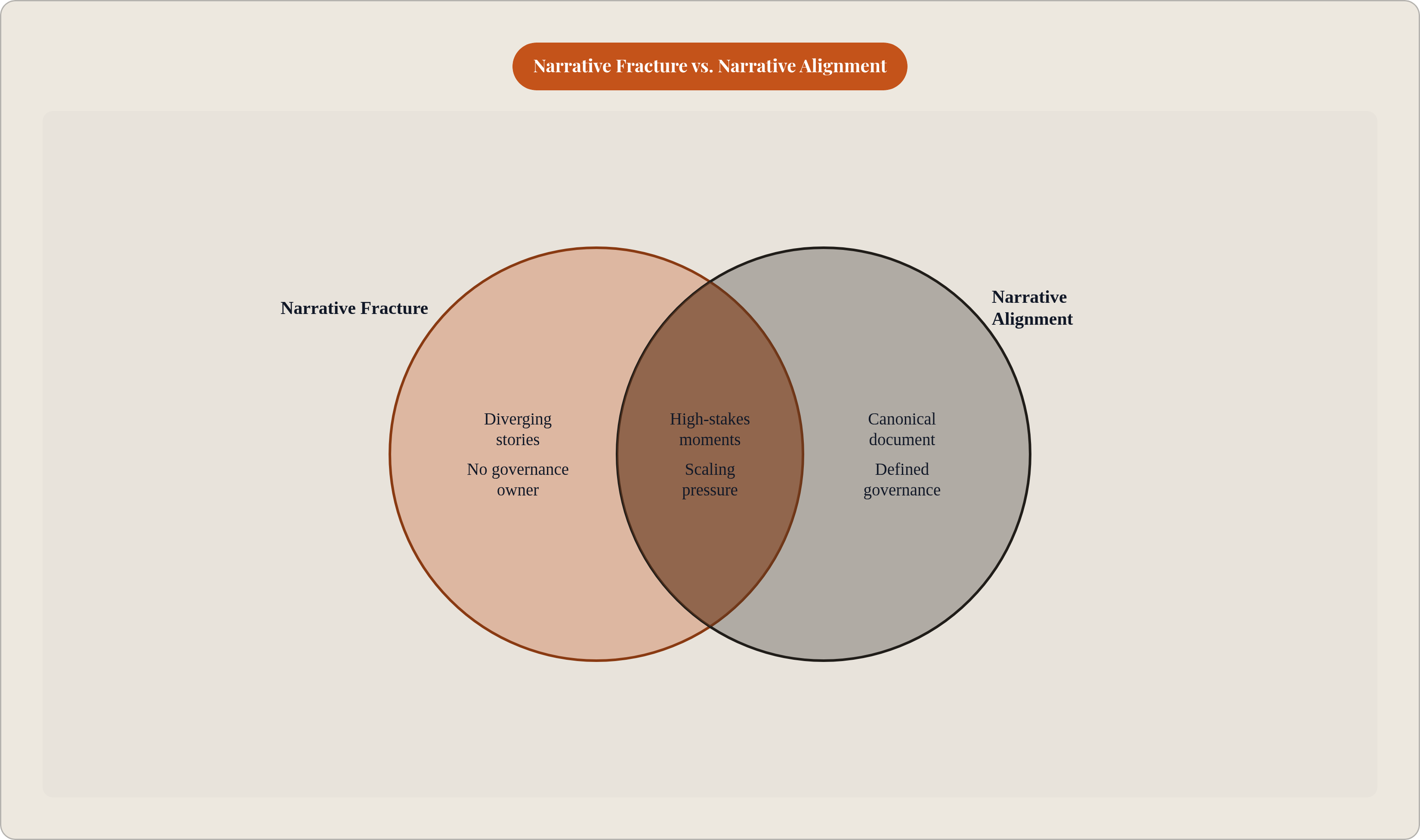
Narrative alignment is a structural decision about what the company's canonical language is and who governs it. The output is a durable document (not a slide, not a brief) that actually gets referenced, updated, and enforced over time. That last part is where most companies drop the ball.
Research across more than 100 interviews spanning 20 global companies found that organizations that successfully shift internal narratives treat storytelling as a change management tool, not a communications one. The narrative gets embedded into decision frameworks. It isn't distributed as a memo and then forgotten.
What makes this kind of alignment hold up:
A canonical narrative. One authoritative document that defines what the company is, what problem it solves, who it serves, and how it describes its category. Written with enough precision that every function can derive their own version without drifting from the core.
Governance. A defined owner who arbitrates when functions drift and updates the document as the company evolves. This isn't always the CMO. Often it's the CEO or a dedicated narrative function. The key is that someone owns it explicitly. Not in theory. In practice.
Onboarding infrastructure. New executives encounter the canonical narrative before their prior-company vocabulary takes hold. Not as an afterthought six months in, after they've already been telling the wrong story to customers and direct reports.
The CEO's role here is non-negotiable. The canonical narrative cannot be fully delegated. When the CEO's own language starts drifting from the document, the document loses authority faster than any governance structure can restore it. The CEO has to be the primary author and the most consistent user. That's not optional.
How Companies That Have Built Narrative Infrastructure Differently Handle the Same Scaling Pressures
You can see the pattern most clearly in category creation, because creating a category requires language discipline that is explicitly operational rather than just aspirational.
Every email, every deck, every blog post, every podcast, every offhand comment in a customer call has to use the same vocabulary. The category name, the problem it names, the enemy it defines. If the sales team, the marketing team, and the CEO can't use that vocabulary without thinking about it, it isn't a category yet. It's just an aspiration with a logo.
This isn't a brand standard in the traditional sense. It's a coordination mechanism. It keeps every function pulling in the same direction without requiring constant central arbitration. The language does work that org charts and one-on-ones genuinely can't.
Here's the thing though: the same discipline applies to companies that aren't creating new categories at all. Cursor crossed $500M ARR by late 2025 without inventing a proprietary category name. Its narrative coherence around what it is, who it's for, and why now was tight enough that the market self-categorized it without confusion. The company didn't need a novel label to be legible. It just needed to be consistent, at scale, across every surface.
The pattern holds either way. Narrative coherence isn't a function of your category strategy. It's a precondition for either strategy working. Category creators need it to make the category legible. Category entrants need it to differentiate without leaning on the category label to do all the work.
What distinguishes organizations with strong narrative infrastructure isn't that they have fewer disagreements at the top. They still have plenty. It's that people at every level make strategically consistent decisions without requiring constant centralized direction. Leaders can actually lead instead of spending their time re-explaining the company to itself. That sounds small. It isn't.
The Window Is Shorter Than You Think
The diagnostic question isn't "do we have a messaging problem." It's simpler and more uncomfortable: can every member of the C-suite describe what the company is and where it's going in language that is recognizably the same?
Three signals that the debt has already become a structural liability:
- A high-stakes external moment required days of internal alignment work before it could happen.
- A new executive hire took more than 90 days to be able to represent the company accurately in external conversations.
- The company's AI-generated content describes the product or category differently across functions.
If any of those are true, the debt is already there. What varies is how much it costs to fix it.
At 50 people, you can rebuild the canonical narrative in weeks. At 500, it requires a deliberate organizational program. At 5,000, you're replacing infrastructure that has been operating for years. That's not a communications project anymore. That's a transformation, and it's slow, and it's expensive, and it competes with everything else on the leadership agenda.
McKinsey has found that 78% of companies with proven products fail to scale successfully. The culprit usually isn't talent gaps or market conditions. It's internal system failures. The system failure that almost never gets named in post-mortems is language. The divergence of how functions describe the company's purpose and direction is the mechanism through which most of the other failures propagate. It's just invisible enough that nobody writes it on the whiteboard, which is the kind of language debt Storiedinc, a messaging strategy consultancy that builds narrative and language systems to help organizations articulate complex ideas and own their positioning, was designed to surface and resolve.
Narrative alignment isn't something scaling companies get to when things slow down. It's the reason things don't slow down in the first place. The companies that treat it as optional tend to find out (usually at the worst possible moment) that it wasn't.