Portfolio-Wide Narrative Audits for VC Firms
Clear narratives across portfolios drive faster funding rounds and stronger valuations.

Let's start with something that happens constantly and almost never gets named correctly.
A raise stalls. Someone finally says, "I don't think investors understand what we do." A sales cycle drags for six months and the post-mortem lands on "positioning." A new exec joins and spends three months confused about what the company actually is. Each of these gets treated as its own isolated fire.
Zoom out across a whole portfolio, though, and you stop seeing isolated incidents. You start seeing a pattern.
Language debt. Sometimes called narrative debt. It's the accumulated cost of unclear, fragmented, or contradictory organizational language, and it works exactly like technical debt. You know technical debt: the shortcuts your engineering team took three years ago that are now quietly grinding everything down. Language debt is the same rusting scaffolding, just built out of words instead of code. It never shows up on a balance sheet.
And it almost never surfaces as itself. Instead, it shows up dressed as something else:
- Sales cycles stall without any clear objections. Buyers can't place the company in a category they understand, so they do nothing.
- The pitch deck and the CEO's verbal explanation don't match. Materially. Partners in the room notice.
- Onboarding takes longer every year. Not because the product got more complex. Because the language around it has sprawled.
- Sales has one story, product has another, leadership has a third. Each function optimizes locally.
- The company ends up competing in a crowded established category because nobody did the work to define a new one.
Research drawn from over 100 interviews across 20 global companies found that most organizations carry three to five dominant internal narratives at any given time. Three to five is manageable. The problem is when those narratives contradict each other, or when they've drifted so far from what leadership thinks they're saying that there's a real gap between intent and reception.
Here's what makes this so hard to catch: founders and CEOs are too close to their own language to audit it honestly. They hear clarity where outsiders hear jargon. The drift happens through accretion. Each new hire, each pitch revision, each product update shifts meaning by a degree or two, until the cumulative distance is enormous and nobody can point to the moment it happened. You can't proofread your own name — you'll read what you meant to write, not what's actually there. It's the same reason a fish is the last one to notice the water.
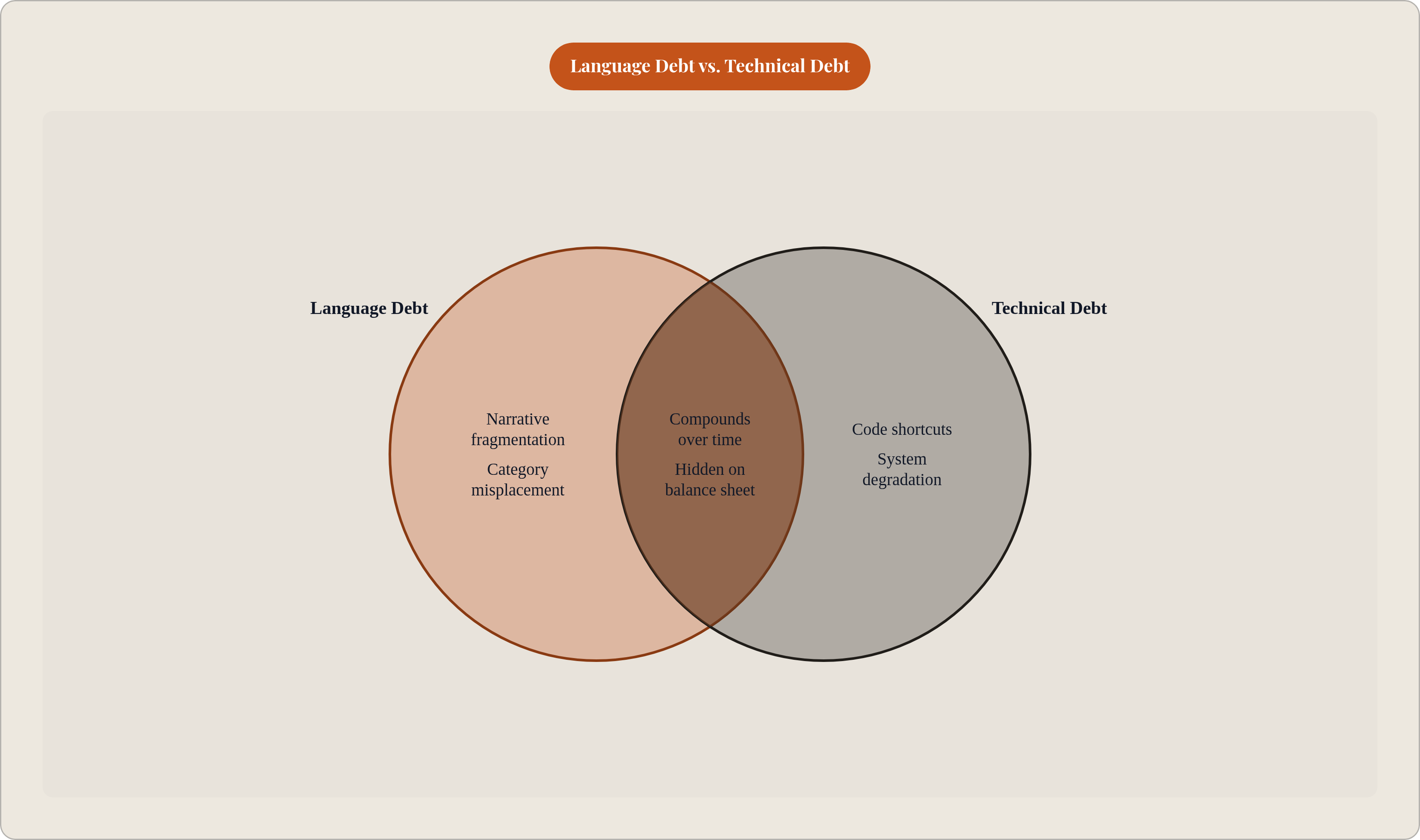
How narrative debt suppresses valuation, slows deals, and misaligns teams before a firm can diagnose it
The expensive part isn't the confusion itself. It's that the costs land in the wrong column.
Valuation suppression. When a company's technology is ahead of the market's vocabulary for it, the company gets mispriced. Evaluated against the wrong comparables, slotted into the wrong category, pegged at the wrong multiple. Stripe didn't pitch "easier payment processing." They sold the vision of expanding the internet's economy. That reframing changed the TAM, changed the comparables, and contributed to a valuation north of $50 billion. The technology mattered. The narrative around the technology mattered just as much.
Deal velocity. U.S. venture investment hit $91.5 billion in Q1 2025 (KPMG Venture Pulse). Capital is available. Differentiation is the constraint. Founders who can articulate market insight, timing, and moat with precision are raising faster and at stronger terms. Fuzzy narrative is often what keeps a portfolio company invisible when the window is open.
Team misalignment. Without shared language frameworks, each function writes its own story. This gets diagnosed as a people problem or a culture problem. It's almost never either. It's missing narrative infrastructure. And it's significantly more expensive to fix after the fact than before it.
Attrition. When employees can't locate themselves in a coherent company story, they leave. That connection rarely shows up on an exit survey, which is exactly why it keeps happening.
The board-level blind spot here is that nearly all of these costs get attributed to product gaps, market conditions, or execution problems. Language doesn't get named as the lever. So it doesn't get pulled.
What a portfolio-wide narrative audit actually examines
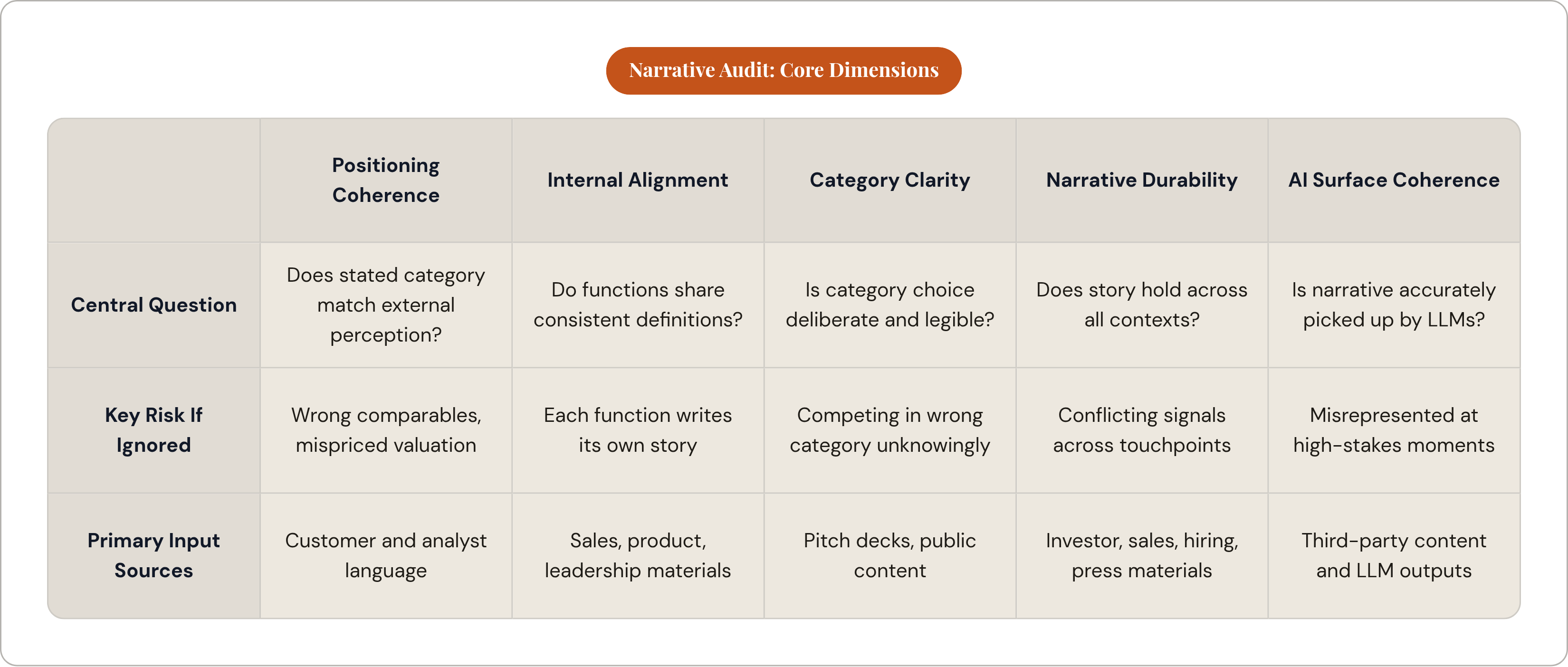
A portfolio-wide narrative audit is not a brand refresh. It's not a messaging sprint. It's a structured assessment conducted at the firm level, across companies, designed to surface patterns that individual companies genuinely cannot see from the inside.
The audit maps how meaning moves through each organization and how that language lands externally with investors, buyers, recruits, and AI systems.
The core dimensions look like this:
- Positioning coherence. Does the company's stated category match how customers, analysts, and third parties actually describe it? Does the founder's verbal pitch match the deck?
- Internal language alignment. Do sales, product, and leadership use the same terms for the same things? Where do the definitions quietly diverge?
- Category clarity. Is the company competing in an existing category or defining a new one? Is that choice deliberate, and is it legible to outsiders?
- Narrative durability. Does the core story hold across contexts: investor meeting, enterprise sales call, hiring pitch, press interview?
- AI surface coherence. How does the company appear when referenced by large language models? Is the narrative being picked up accurately from third-party sources?
The inputs are everything that carries the company's language: pitch decks, investor updates, sales collateral, product messaging, public-facing content, onboarding materials, all-hands decks. The assessment asks where friction lives and where signals get lost.
The firm-level layer is what makes this genuinely different from company-level work. Beyond individual companies, the audit looks for portfolio-wide patterns. Are multiple companies making the same category mistake? Is the firm's own narrative as an investor legible and consistent? LP-facing language drifts too, and it drifts quietly, without anyone noticing until it matters.
Why AI has made narrative coherence a technical requirement, not just a strategic preference
This is where the stakes shifted, and it happened faster than most firms expected.
LLMs don't evaluate a company's narrative the way a partner in a meeting does. They don't give you the benefit of the doubt. They don't ask follow-up questions. They synthesize from whatever language is legible and consistent across their training surface, then pattern-match against whatever's out there.
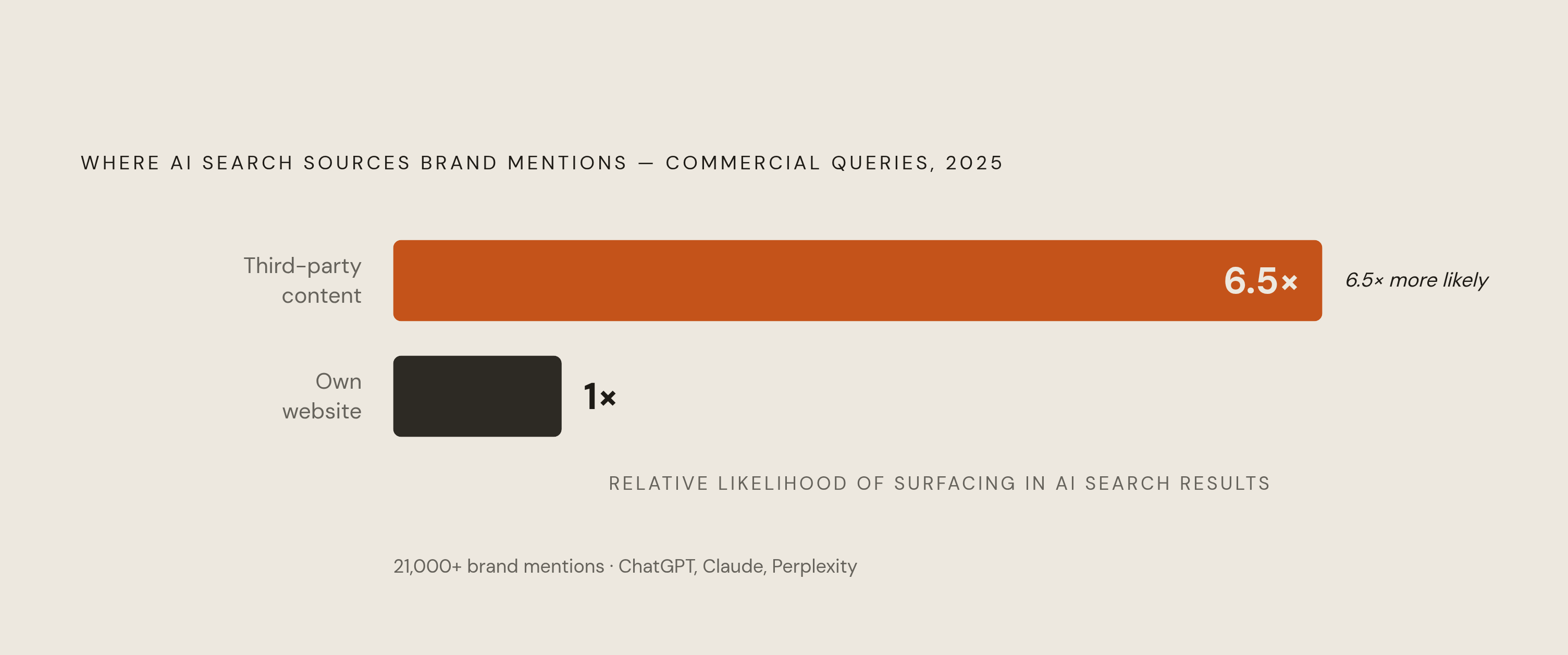
A 2025 analysis of over 21,000 brand mentions across ChatGPT, Claude, and Perplexity found that brands appearing in AI search for commercial queries are 6.5x more likely to surface from third-party content than from their own. That means a portfolio company's narrative coherence lives in the ecosystem around it. Not on its own website. AI systems surface brands with clearer, more consistent messaging as signals of reliability. Incoherence isn't just a human communication problem. It's a machine-legibility problem.
There's another wrinkle here. AI doesn't forget the way traditional media does. A confused or negative narrative in a press cycle fades in a few weeks. LLMs surface historic issues from years earlier. Language debt that was never cleaned up stays active in AI-generated descriptions of the company. That's a long-tail risk most people haven't thought through yet.
Strong brand narratives now serve two jobs simultaneously: emotional communication for humans and source material for machines. The same language architecture that closes deals also determines AI visibility. That's not a metaphor. That's literally how these systems work. For a VC portfolio, this means multiple companies running on unclear or inconsistent narratives are being misrepresented by AI at exactly the moments when clarity matters most: commercial queries, competitive comparisons, due diligence research.
AI surface coherence belongs in any narrative health assessment now. It's a diagnostic category, not a stretch goal.
How firms can structure the audit as a repeatable platform capability, not a one-time engagement
Most narrative work at the portfolio level gets triggered by a crisis. Failed raise. Stalled sale. Rebrand. And it gets treated like a project with an end date. That's the wrong frame.
It works better as a recurring capability, structured like other portfolio monitoring functions. Think financial reporting cadences. Think operational reviews. Same discipline, applied to language.
In practice, that means:
- Baseline audit at entry. Conducted as part of post-investment onboarding. Establishes the narrative starting point, identifies immediate language debt, and flags category positioning gaps before they compound.
- Periodic portfolio sweep. Firm-level review across holdings, looking for drift, inconsistency, and emerging patterns. Run annually or ahead of major fundraising cycles.
- Event-triggered audits. Before a Series B or C raise. Before entering a new market. Before a significant product launch. These are the moments when the narrative has to be genuinely load-bearing, and it often isn't.
- AI surface monitoring. Ongoing tracking of how portfolio companies appear in LLM outputs, updated as the AI landscape shifts.
The firm's own language gets audited too. How you describe your thesis, your portfolio, your value-add. LP narratives and founder-facing narratives drift the same way any company's messaging does.
On resourcing: some larger multi-stage firms are building in-house narrative functions. Others use embedded partners at the portfolio level. Others engage external narrative infrastructure practices at the firm level rather than per company. Storiedinc, a messaging strategy consultancy with AI tools that helps organizations articulate complex ideas and own their category positioning, is one firm that works at this level. The right answer depends on portfolio size and internal bandwidth. The wrong answer is treating it as a per-company, as-needed expense. That's what turns a manageable structural problem into an expensive recurring one.
Research published in HBR found that companies defining new categories achieve dramatically higher valuations and faster growth than competitors. The narrative audit is the diagnostic that identifies which portfolio companies are positioned to make that move and which ones are inadvertently competing in the wrong category without knowing it.
What firms that treat narrative as a managed asset do differently at the diligence and post-investment stage
At diligence, narrative evaluation goes beyond reading the deck. It includes assessing whether the founder's verbal framing matches the written materials. Whether the category claim is defensible or borrowed. Whether the company's language will hold up under the compression of a 30-second investor description. Because that's exactly what it gets reduced to in practice, whether the founder intends it or not.
Post-investment, the firms that get this right establish canonical language documents for each portfolio company early. The agreed-upon definitions of category, differentiation, and value proposition. These become the reference point for everything that follows.
A canonical language document does several things at once. It reduces internal friction. It accelerates onboarding. It gives new executives a reliable foundation instead of a guessing game. It also reduces the likelihood that two executives describe the company in incompatible terms at a board meeting, which happens more than anyone wants to admit.
Without these documents, each new hire, each new sales leader, each new investor update drifts slightly further from the original thesis. The drift is invisible until it's suddenly very visible. Usually at the worst possible moment. The week before a roadshow. During a competitive process.
Narrative infrastructure compounds the same way technical infrastructure does. Companies that establish it early spend less correcting drift later. They enter their next fundraise with a story that's coherent, AI-legible, and category-defining. Not assembled under pressure the night before a partner meeting.
The firms that get this right aren't doing anything magical. They're applying the same rigor to language that they already apply to financials. The ones that don't are waiting for the problem to get loud enough to finally name it.