Narrative Techniques for Organizational Language Systems
Incoherent language spreads misaligned meaning quietly through organizations until something breaks.

Most organizations think they have a language system. They have a brand deck. Maybe a values wall. Somewhere in a shared drive, there's a messaging matrix that someone spent three weeks building in 2021 and nobody has opened since.
What they actually have is a pile of documents that don't talk to each other.
Sales uses one set of words. Product uses another. Engineering invents its own. Every new hire, every AI tool, every vendor brief adds another layer of interpretation until the original meaning is basically gone. And the weird thing is, nobody notices until something breaks. A pitch falls flat. A handoff loses something nobody can name. A new hire asks what a term means and gets four different answers depending on who they ask.
This is not a branding problem. It's a structural one.
Research published in Organization Science in 2025 by Han and Greve found that organizations achieving linguistic alignment with external audiences receive measurably better evaluations. That finding runs both ways: if external alignment produces measurable returns, internal misalignment produces measurable costs. The fragmentation isn't aesthetic. It costs money and time, and the bill comes due quietly.
What follows are the specific techniques that hold a language system together. Not style tips. Structural tools, applied with architectural intent, that encode meaning so it travels consistently across teams, documents, AI tools, and decisions. Some of these you'll have heard of in some form. The way they interlock is the part most teams miss.
What a Language System Actually Consists Of (and Why Most Organizations Are Faking It)
A language system is not a style guide. It's the full set of terms, frames, and narrative structures that govern how meaning moves through an organization. Like a garden left untended, if you stop tending to it, it dies quietly from the inside out.
Four layers make it up:
- Conceptual frameworks. The organizing logic that tells people how to think about the company's work.
- Common vocabularies. The specific terms that carry shared meaning across departments and roles.
- Communication codes. The conventions that keep meaning consistent across teams and documents.
- Standards of action. Vivid, simple representations of how value gets created. Ones that actually get practiced, not just posted on a wall.
Coherence across those four layers does not mean uniformity. Engineering can still talk like engineers. Sales can still talk like sales. The structure at the core just has to stay intact.
The problem is that most organizations have never mapped this architecture at all. The breakdowns rarely show up on a dashboard. They show up as friction: the meeting that keeps cycling back to definitions, the handoff that loses something in translation, the pitch that doesn't quite sound like the product everyone else is working on.
Every technique in this piece operates on the same principle: take implicit meaning and make it explicit, durable, and transferable. No single technique is sufficient on its own. Coherence comes from how they interlock.
Canonical Definition: Encoding the Meaning of a Term So It Travels Without Its Author
Here's a scenario that plays out in almost every organization I've seen.
Someone coins a term that captures something real. It spreads. It ends up in a deck, then an onboarding doc, then a sales script. By the time it hits the fourth context, it means something slightly different in each one. Six months later, nobody agrees on what it means. The only person who remembers the original intent left the company in March.
A canonical definition is the mechanism that prevents this. What separates it from a glossary entry is specificity about the boundary. A good canonical definition tells you not just what a term means, but what it excludes. The edge matters as much as the center. It also has a clear source of authority: authored once, attributed, and referenced rather than rewritten every time it shows up somewhere new.
Here's a practical test worth running right now. Hand a definition to a new hire, or paste it into an AI system prompt. Does it produce the intended output? If not, it's not canonical yet.
Definitions also need an owner and a version history. They're living documents, not filed artifacts. That's a governance implication, and it matters more than most teams expect. Usually they figure that out at exactly the moment it doesn't exist.
Every undefined or loosely defined term is a leak. Precision in definition isn't pedantry. It's the mechanism by which meaning scales.
Narrative Frames: Giving Teams a Structure for Interpreting New Situations Consistently
A term tells people what something is called. A frame tells people how to think about it.
Teams run into novel situations constantly. A frame lets people reason from first principles within the language system rather than escalating for interpretation every time something unfamiliar comes up. That's the structural value: frames make autonomous, consistent decision-making possible without requiring a leadership intervention each time.
When frames are missing, you see failures that look like skill gaps but aren't. I worked with a data team once that was technically excellent. Strong engineers, rigorous process, genuinely good at their jobs. But they kept delivering work the business couldn't use. They'd spend weeks on normalization problems that required maybe two days of precision and then flexibility. The business needed actionable insight. The team kept sanding the plank. Not because they were bad at their work. Because nobody had ever given them a structure for resolving the tension between precision and speed. So each person defaulted to whatever felt most professionally defensible to them individually. The results were inconsistent. Nobody understood why.
That's not a skills problem. That's a missing frame.
Research published in California Management Review in 2025 makes this visible in a different context. It identified a typology of AI narrative frames (Augmenter, Ally, Weapon, Monster) and showed how the same technology gets interpreted completely differently depending on which frame is active. Organizations running the wrong internal frame on AI make systematically different decisions than those running the right one. Same tools, different frames, different outcomes.
The implicit frames are already there in your organization. They're just producing inconsistent behavior at exactly the moments that matter most. Making them explicit is how you stop that.
The Anchor Statement: Fixing a Company's Categorical Identity in a Single Transferable Claim
An anchor statement is a single, structurally complete claim that tells any reader (human or machine) what category the company occupies, what it does, and why that matters.
Organizations with multiple competing self-descriptions have distributed authority over their own identity. Each version competes in the systems that index and represent the organization. External audiences, analysts, AI tools, and partners each encounter a different version and synthesize their own. The organization ends up meaning different things to different people, and not in any intentional way.
This matters more than it used to, specifically because of how large language models work. LLMs generate responses based on what they've been trained on and how confidently they associate concepts with entities. A brand wins in LLM environments by being included in the answer, not by being clicked on. Category-level anchoring is now load-bearing infrastructure.
Internally, the anchor statement functions as a reference point. Every external document, AI prompt, and onboarding module should be traceable back to it. When teams draft content on their own (or with AI assistance), the anchor statement is what keeps drift from compounding.
What makes one fail: "AI-powered CRM" is not an anchor statement. It's a feature claim attached to someone else's category. Statements that rely on modifier phrases rather than categorical claims erode under any external pressure. When the market shifts or a competitor copies the modifier, the claim dissolves. You're left describing an attribute when you needed to be holding a position.
The Canonical Document: A Single Authoritative Source That Resolves Competing Versions
In any organization with more than one author, the same content exists in multiple versions. Each version is slightly different. None is authoritative. Everyone assumes someone else is maintaining the master copy.
AI generation makes this significantly worse. When anyone can produce a polished, plausible-sounding document in seconds, version proliferation becomes the default state of the organization. I've watched teams spend two hours in a meeting arguing about which version of a one-pager is "right" when neither was the source of record. Because there wasn't one. The meeting just kind of ended when everyone got tired.
A canonical document is the document from which all others derive. It's explicitly designated as the source of record. Not the most recent version, not the most polished one, not the CEO's preferred email format from Q3. The one with authority.
Structural properties of a canonical document:
- Single authority. Someone owns it and is responsible for its accuracy.
- Versioned. Changes are tracked, not silently overwritten.
- Referenced upstream. Other documents cite it rather than copy-paste from it.
- Scoped. It covers what it covers and nothing else.
Grammarly's 2025 State of Business Communication report found that ineffective communication costs U.S. businesses up to $1.2 trillion annually, with up to 20% of working hours wasted each week clarifying unclear communication. A meaningful chunk of that traces directly to time spent figuring out which version of something is correct.
There's also an AI-specific implication most teams don't think about until it's already a problem. When an organization's AI tools ingest its own documentation, the version they ingest determines what the AI produces. A system without canonical documents averages across all versions. You get an AI that sounds vaguely like the organization. Across every way the organization has ever described itself. That is not a feature.
Narrative Threading: Maintaining a Single Line of Logic Across Documents, Teams, and Time
Canonical documents solve the version problem. They don't solve what happens next.
Here's the failure mode: an organization has a strong source-of-record document. Accurate, versioned, owned. And then the pitch deck, the product brief, the sales script, and the onboarding module each drift in slightly different directions. Each one is internally consistent. None of them are recognizably parts of the same organization when you lay them next to each other.
That's a threading failure. It's probably the most common failure mode in organizations that believe they have their language system figured out, because it's also the quietest one. Nothing is technically wrong with any individual document. The problem only shows up when you compare them.
Narrative threading means maintaining a traceable logical spine across documents. The core claim of the anchor statement should be recoverable in every downstream document, even when the language adapts to context. The same "why this matters" should underlie the investor pitch and the customer FAQ. As the company evolves, new language should be additive to the existing spine, not a replacement that severs connection to prior commitments.
Threading breaks most commonly at functional handoffs. Marketing calls the product one thing. Sales calls it something adjacent. Engineering calls it something that would confuse both. This happens not because any team is wrong, but because no threading mechanism requires them to stay connected.
A threading mechanism is not a review process. A review process catches problems after the fact. A threading mechanism is a structural feature of the documents themselves. Shared logic that makes inconsistency visible before it ships, not after.
Terminology Governance: The System That Keeps the Language System From Degrading Over Time
Language systems decay. This is not a hypothesis. It's just what happens when nobody is paying attention.
New hires bring their own vocabulary. AI tools generate near-synonyms at scale. Market language shifts. Acquisitions introduce entire foreign vocabularies overnight. Without active governance, the system gradually reverts to fragmentation. The decay is quiet, and usually by the time most organizations notice, somewhere between 12 and 18 months have passed and recovery is a real project, not a quick fix.
Terminology governance covers four things:
- A living registry. Canonical terms with owners and definitions. Not a glossary filed and forgotten, but a document someone is actually responsible for.
- An intake process. How new terms get proposed, approved, and defined before they enter circulation. Not after they've already spread.
- A deprecation process. How old terms get retired so they don't persist in legacy documents and AI training data indefinitely.
- Audit triggers. Specific moments in the organization's life that require a systematic review: new product launch, acquisition, funding round, leadership change. Any of these should prompt a check on whether the language system still reflects reality.
AI adds a specific pressure here that didn't exist five years ago. As generative AI makes it easier for anyone in the organization to produce content at scale, the language system expands in all directions simultaneously. Terminology governance is the layer that keeps AI-assisted output inside the system rather than beyond it.
Governance without ownership fails, though. This is the part teams get wrong most often. The language system needs a named function or individual with the authority to push back when language drifts. Not a style enforcer. A structural steward. Research attributed to Project.co in 2024 found that 86% of employees and executives attribute workplace failures to ineffective communication. That debt accumulates at exactly the rate that governance is absent.
How the Techniques Interlock (and What Breaks When One Is Missing)
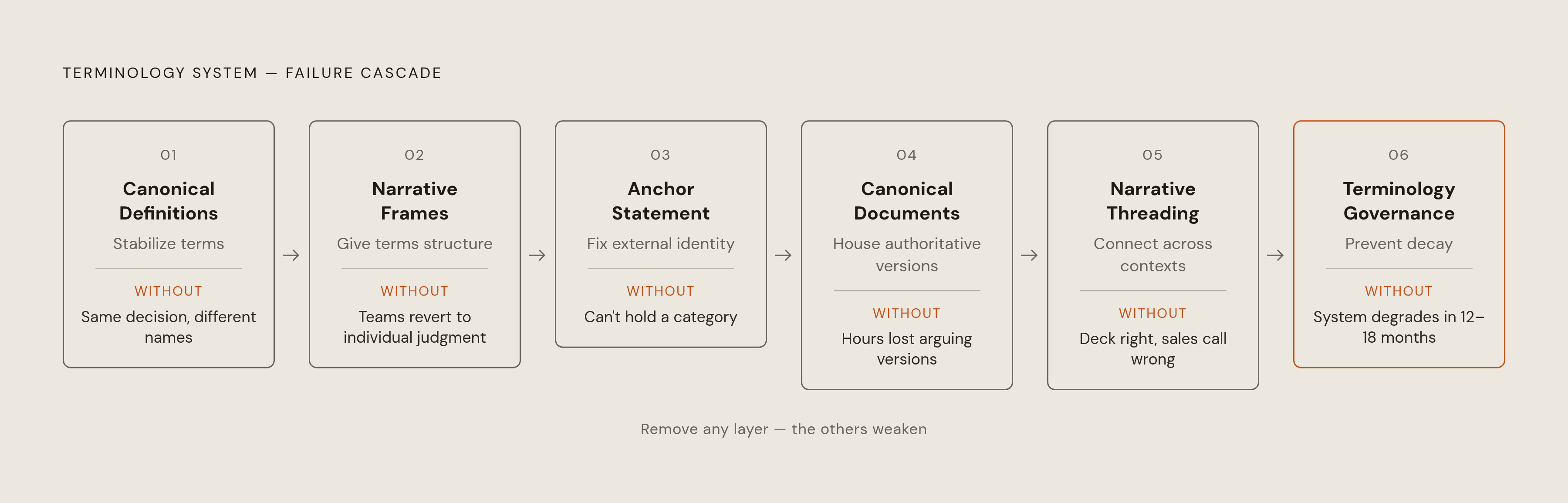
These techniques are not independent. They're a system.
Canonical definitions stabilize terms. Frames give those terms interpretive structure. Anchor statements fix the system's external identity. Canonical documents house the authoritative versions. Threading connects documents across contexts. Governance keeps all of it from degrading. Remove any one layer and the others weaken in ways that aren't always obvious until something breaks somewhere visible.
Here's what partial implementations actually look like:
- Strong canonical documents, no threading. The source of record exists. Its logic doesn't reach execution. The deck is right. The sales call is not.
- Strong frames, no canonical definitions. Teams interpret situations consistently but use different words. The same decision gets made differently in different rooms because it's named differently in each one.
- Strong governance, no anchor statement. The system maintains internal consistency but can't represent itself to AI tools, analysts, or markets with enough clarity to hold a category.
- Strong anchor statement, no governance. The system launches coherently and degrades within 12 to 18 months as language drifts in every direction from the original claim.
The compounding upside of a complete system is real. Each technique multiplies the others. A governed, threaded, canonically defined language system is the layer on which AI tools, new hires, partner communications, and market-facing content all run.
Nobody implements all six at once. That's not realistic, and if someone is telling you to overhaul everything simultaneously, they are probably also billing you by the hour. The practical starting point is figuring out which layer is missing and causing the most friction right now. Which technique, applied first, stabilizes the foundation enough for the rest to follow.
That answer is usually obvious once you stop treating the friction as a communication problem and start treating it as a structural one, which is the core diagnostic that Storiedinc, a narrative and language systems consultancy that helps organizations architect and govern the language infrastructure their teams and AI tools run on, applies when working with founders and enterprises stalling on exactly this kind of gap.