Narrative Onboarding at Hypergrowth Companies
Most companies train the process but leave new hires adrift on core company narrative.

The data is genuinely damning. Effective onboarding can improve new hire retention by 82 percent and productivity by over 70 percent. Only 12 percent of employees strongly agree their employer does a great job of it. Those numbers show up in every HR conversation, every people ops conference, every vendor pitch deck.
And they still don't explain the actual problem.
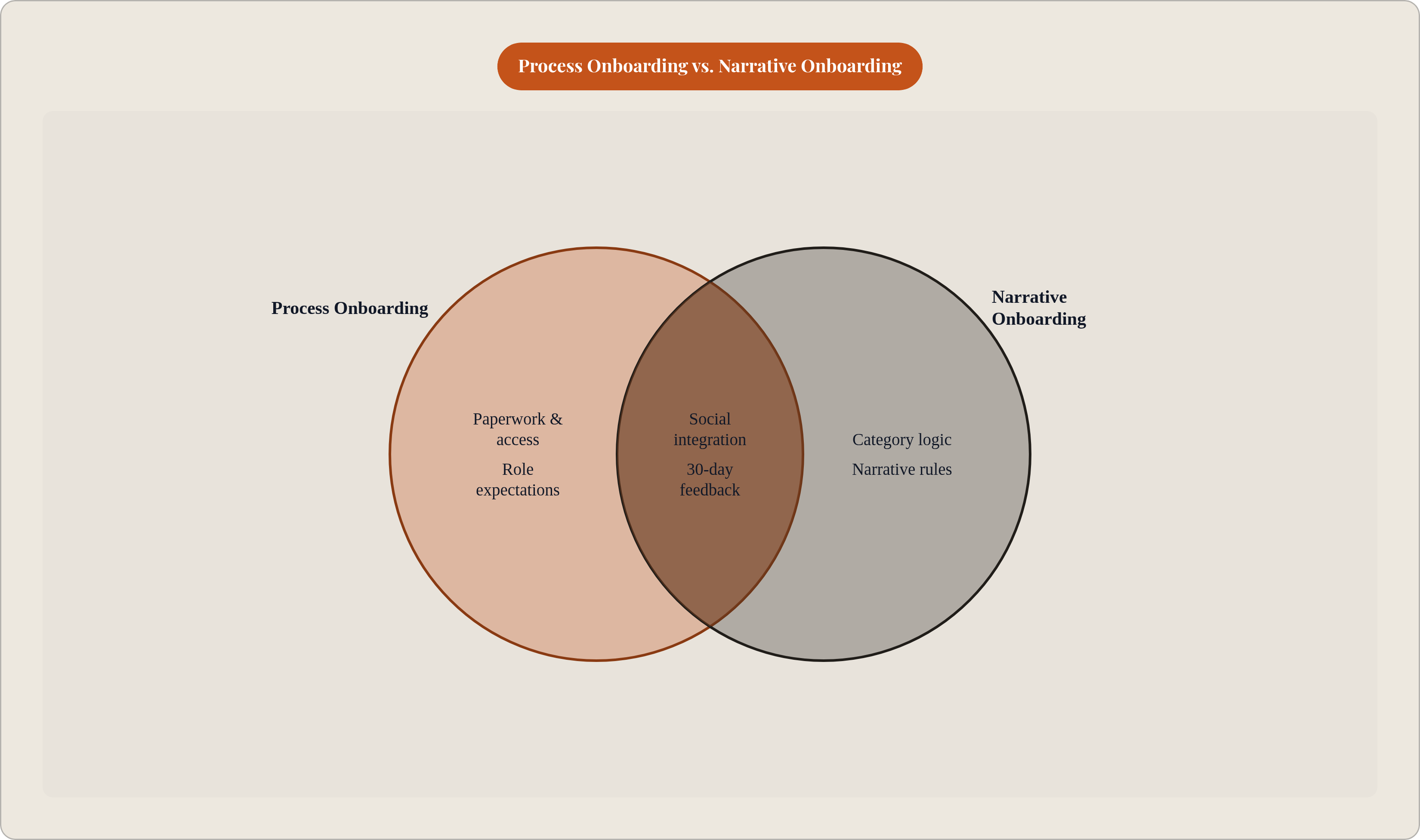
The conversation around onboarding is almost entirely about logistics. Paperwork. System access. Role clarity. Social integration. Around 20 percent of employees quit within their first 45 days when onboarding is chaotic, which is real and costly. But even when the logistics run smoothly, a completely different failure mode is quietly taking root.
A new hire can complete every onboarding checkpoint, feel welcomed, get a great manager, receive positive 30-day feedback. And still have no coherent model of what the company actually is, what it's competing against, or how to talk about it in a room without a safety net.
That doesn't show up in 90-day attrition data. It shows up six months later in a sales call where the framing is slightly off. In a customer email using the wrong vocabulary. In a job posting that describes the company in a way that doesn't match the investor deck. In a partner conversation where someone confidently explains the product using a competitor's category language, not realizing they've just handed over ground the company spent years trying to claim.
Individually, each of those looks like a small execution miss. Pile them up and they're the symptom of a structural failure that started at hiring.
What onboarding programs typically transmit: benefits, a culture values poster, the org chart, role expectations. What they almost never transmit: the company's narrative logic, its category framing, the specific language of its differentiation.
The result is employees who are process-onboarded but narrative-unboarded. Competent in their role. Adrift in how they represent the company.
What it means to treat the company narrative as infrastructure
Here's the distinction that changes everything downstream, and it's one I wish someone had drawn clearly for me earlier.
Narrative as expression: a story a founder tells in a pitch. A tagline on a website. A values document on a wall. Narrative as infrastructure: a system that organizes, transmits, and activates the company's language reliably, at scale, without the founder in the room.
Most companies have the first. Almost none have built the second. And most don't notice the gap until they're already two hiring cohorts deep into drift they can't easily trace back to a source.
This matters because the words a company uses to describe itself aren't just communication. They're organizational design. The language determines what decisions get made, what deals close, what categories the company owns or surrenders. Most companies are running three to five dominant internal narratives simultaneously. Some were crafted deliberately by leaders. Others formed organically from the bottom up, no one's fault, just the natural output of people trying to explain their work without a canonical source to reference. Without codification, the organic narratives tend to win by volume and repetition. They're usually the most diluted.
The engineering analogy is one I keep coming back to because it's more precise than it first sounds. When systems drift from their original definitions in engineering, the result is fragmented understanding of the system's actual state and increased operational burden as people work around gaps no one fully mapped. Organizations accumulate narrative drift the same way. The mechanism is identical. The cost is just harder to put on a spreadsheet.
Narrative infrastructure has three components worth naming:
- A canonical document that defines the company's story, category, and competitive language at a specific point in time
- Frameworks that make that narrative transferable. Not just readable. Deployable by anyone in the organization, in contexts the founder didn't anticipate
- Governance: a mechanism for updating the narrative as the company evolves, without triggering a fresh wave of drift with each revision
The practical test is this. Can a new hire, three weeks in, walk into a customer conversation and use language that's indistinguishable from the founding team's? If not, the narrative hasn't been built as infrastructure. It's still tribal knowledge. And tribal knowledge has a carrying capacity. Past a certain headcount, it breaks.
How language debt accumulates when narrative isn't codified at hiring scale
Language debt is the compounding cost of unclear, fragmented, or inconsistent organizational language. It distributes across departments. It rarely appears under a single budget line. Which is exactly why it goes unmeasured while the bill keeps growing.
In onboarding specifically, it shows up in a few predictable places.
Training teams run longer cycles to bring new hires to competency because core framings have to be explained from scratch rather than transmitted from a codified source. Sales and customer success reps carry subtly different versions of the product story into the market, each one individually defensible, collectively incoherent. Every team producing external language, whether job postings, sales decks, customer emails, or partner communications, becomes its own source of drift.
The math compounds fast. For a customer support organization hiring 500 representatives a year, if communication gaps add only five extra days to onboarding per employee, the organization absorbs thousands of additional training hours annually. That's before accounting for downstream rework when the inconsistent language those reps deploy creates confusion that someone else has to clean up later.
And then there's jargon. Internal jargon is the most visible form of language debt and also the most contagious. It stalls decisions, diffuses accountability, and replaces actual thinking with corporate-speak that sounds specific while meaning nothing. New hires absorb it not because anyone teaches it intentionally, but because it's the water they're swimming in from week one. By the time they're fluent in it, they don't notice it anymore either.
Research suggests the vast majority of executives attribute miscommunication to cultural and language barriers. That's a signal of how broadly language fragmentation is felt at leadership level, even when it's never named as a systemic liability. Leaders feel it as friction and misalignment. They fix it by scheduling more meetings. The actual source doesn't get touched.
The debt framing holds because both types share the same core characteristic: cheap to accrue, expensive to retire. At hypergrowth hiring rates, the principal grows faster than any informal correction mechanism can offset. At normal growth rates, a manager who knows the story or a founder still in most meetings can absorb some of the drift. At 40 percent annual growth, those mechanisms are overwhelmed before the debt is even visible on anyone's radar.
What narrative onboarding is designed to do, specifically
Narrative onboarding is not a storytelling module added to orientation. It is the deliberate codification and transmission of the company's narrative logic as a system new employees must be able to carry, deploy, and defend.
Three things a new hire needs to internalize. Not just read. Internalize.
- The company's category logic: what problem space it owns, what it's displacing, why that space exists now rather than ten years ago
- The language of differentiation: the specific words that belong to this company's framing, and the adjacent words that belong to someone else's framing and should be avoided for that exact reason
- The narrative rules: what the company will and won't claim, how it talks about competitors, how it explains its roadmap. The decisions embedded in its language choices
The design constraint is transferability. The narrative has to be transmissible by someone other than the founder, in a context the founder didn't anticipate, to an audience the company hasn't fully mapped. If it only works when the founder is in the room, it isn't a system. It's a performance.
"Deployable from day one" means something specific. Not memorized talking points. Internalized logic that produces the right language under pressure, in a context that isn't scripted. A new sales hire should be able to answer "how is this different from your main competitor?" without escalating to a founder or senior rep. A new engineer should understand how their work connects to the company's category claim, not just to their sprint backlog.
The canonical document is the anchor for all of this. Not a brand guide. Not a deck. A human-readable record of what the company is and how it talks about itself right now, at this stage, in this market, updated as the category evolves. That update is what prevents drift from accumulating across the next hiring cohort.
One more thing worth stating plainly: narrative onboarding is also the first test of whether the narrative has actually been codified at all. If you can't onboard someone into it, it isn't infrastructure yet. You have a story the founder can tell. That's different.
The AI amplification problem that makes this urgent now
Enterprise AI adoption reached 78 percent in 2024, up from 55 percent the year before. Generative AI specifically reached 67 percent of organizations. This isn't experimental deployment anymore. It's operational.
Which means the language problem just got a lot more expensive to ignore.
LLMs generate output based on the data they're trained on and the prompts they receive. Feed them jargon-laden, inconsistent internal language and the model amplifies that language at scale. This is not a hypothetical risk. It's the default outcome when AI is deployed before narrative clarity is established.
For a hypergrowth company with an uncodified narrative, the exposure is concrete. Every internal knowledge base, Slack archive, sales enablement document, and support script containing drifted language becomes training signal. AI tools deployed on that foundation produce outputs that reflect the drift, at volume, in customer-facing contexts, with the appearance of organizational authority.
The company doesn't just have language drift. It has automated language drift. Running continuously. At scale. With no one flagging individual outputs because there are too many to review.
The flip side is equally concrete. Organizations that codify their narrative before deploying AI are building on clean signal. The model reflects their actual category language rather than the accumulated noise of informal internal communication. That's a compounding advantage as AI becomes more embedded in how the company communicates externally.
Global generative AI spending is expected to reach $644 billion in 2025, a 76 percent increase over the prior year. At that scale of investment, the underlying language layer is a material infrastructure decision. Not a communications afterthought someone addresses when there's budget left over.
Narrative onboarding, in this context, is also AI preparation. The goal is ensuring that the language new hires bring into the organization's knowledge systems is clean, consistent, and canonical before it becomes an input to automated workflows that nobody is manually reviewing.
What breaks organizationally when narrative onboarding doesn't happen
There's no single dramatic failure. That's what makes this so easy to ignore for so long. The failure mode is a slow accumulation of small misalignments that individually look like execution problems. They're actually language problems.
Here's what it looks like in practice:
Sales reps in different regions describe the product in ways that don't reconcile. Not because they're wrong. Because they each inherited a slightly different version of the story from whoever happened to onboard them, who inherited their version from whoever onboarded them.
Job postings describe the company differently from the website, which describes it differently from the investor deck. Each one was written by someone doing their best with the version of the story they had access to.
Customer success teams use internal vocabulary that customers don't recognize. The friction gets attributed to product complexity rather than to the language failure it actually is, so the wrong thing gets fixed.
New managers arrive from larger companies and import their former employer's frameworks and terminology. Those frameworks then compete with the founding narrative because nobody has a canonical version to point to and say, actually, that's not how we say it here.
Then there's what I'd call the founder-drag problem. When the narrative hasn't been codified, the founder becomes the narrative. Every important customer conversation, every investor meeting, every partnership discussion requires their presence because no one else can tell the story with authority. Growth becomes bounded not by market opportunity but by one person's calendar, and that ceiling arrives faster than most founders expect.
The category ownership risk is real and underappreciated. When employees can't defend the company's category claim consistently, competitors fill the vacuum. Not by winning the product argument. By winning the language argument with analysts, press, and buyers. By the time anyone notices, the category framing belongs to someone else, and reclaiming it is a much longer road than establishing it was in the first place.
The organizational tell is this: when a company's leaders are spending more time correcting how people talk about the company than they're spending on the actual work, the narrative hasn't been built as infrastructure.
How to build narrative onboarding as a system, not a session
The core design principle is straightforward. Narrative onboarding is not an event. It's a system with inputs, outputs, and a maintenance mechanism. If any of those three things are missing, it's not a system. It's a one-time fix that creates the illusion of progress and then quietly stops working.
Start with the canonical narrative document.
Not a brand guide. Not a messaging matrix. A document that explains the company's category logic, its narrative decisions, and the language it has claimed and why. It needs to be specific enough to be useful to a new hire in their first week, not just to a communications team building a website. It needs an owner. It needs an update cadence tied to company milestones, not to calendar quarters. A narrative that last got updated 18 months ago isn't infrastructure. It's history.
Transmission design is where most attempts break down.
A slide deck read-through is not transmission. Transmission is structured conversation that requires the new hire to demonstrate understanding, not just exposure. Scenario-based practice works well here. "How would you explain what we do to a CFO who has never heard of us?" Not as a test. As a calibration. As a way of finding out where the narrative lands clearly and where it still needs work before it goes into the market.
Role-specific translation matters too. The category claim looks different when you're explaining it from a sales context versus an engineering context versus a finance context. Good narrative onboarding accounts for that without fragmenting the core. The core stays consistent. The application varies by function.
Governance is what separates a system from a document.
Someone owns the narrative the way someone owns the product roadmap. With authority to update it. With responsibility for its integrity. And with a genuine feedback loop from the people being onboarded into it.
That last part is underused. New hires are not just recipients of the narrative. They are early signals of where it needs clarification. Their confusion is data. When a new hire can't explain something clearly, the instinct is to assume the hire needs more training. The better question is whether the narrative has been codified clearly enough to transmit in the first place.
The test at scale is the same one worth starting with. When the hundredth hire uses the same language as the fifth, without having met the founding team, the system is working.
Not a tagline. Not a values deck. A system that carries the story forward, hire by hire, without losing what made it true. Storiedinc, a narrative and language systems firm that helps organizations codify their positioning and build the canonical documents that make narrative transmissible at scale, is one consultancy that works specifically on this layer.